

When people ask “Which eCommerce type is most profitable?” they are usually hoping for a simple answer, a single model that guarantees high profits. Drop shipping. Amazon FBA. Digital products. Subscriptions. Print-on-demand. Influencers often promote one of these as “the best”, but that framing misses the real truth.
There is no magic eCommerce model.
Profitability does not come from the model alone, it comes from how the business is built. The better question is not which model is most profitable in theory, but Which eCommerce type offers the strongest long-term profit potential when executed correctly?
Revenue vs Profit: The Trap That Misleads Most Beginners
One of the biggest mistakes in eCommerce is confusing revenue with profit.
A store doing £1 million in sales with thin margins can make less money than a smaller store with strong margins and repeat customers. Big numbers look impressive, but net profit is what actually matters.
True profitability is what remains after:
-
Product and fulfillment costs
-
Advertising
-
Platform fees
-
Returns and refunds
-
Software and operations
Any model can look profitable on the surface. Only a few stay profitable over time.
What Actually Makes an eCommerce Business Profitable
Across all successful eCommerce businesses, the same drivers show up again and again:
1. Strong Margins
High gross margins give you room to advertise, make mistakes, and scale.
2. Low Customer Acquisition Cost
If it costs too much to acquire a customer, the business eventually breaks.
3. High Lifetime Value
Repeat purchases and subscriptions dramatically increase profit potential.
4. Operational Simplicity
Complex operations quietly destroy profit through time, errors, and stress.
The most profitable eCommerce types combine high margins, repeat customers, and low friction.
Digital Products: The Highest Margins (With a Catch)
Digital products, courses, software, templates, memberships, often look like the most profitable eCommerce type on paper but Why?
-
No inventory
-
No shipping
-
No manufacturing
-
Near-zero cost per additional sale
Gross margins of 80–95% are common, and scalability is unmatched. However, digital products have a trust barrier. You must convince people to pay for information or access. That requires real expertise or credibility, Strong branding or positioning and Excellent marketing and when done well, digital products can be extraordinarily profitable. When done poorly, they struggle to sell at all.
Subscription eCommerce: Profit Through Compounding
Subscription businesses change the economics of eCommerce entirely.
Instead of fighting for new customers every month, revenue stacks over time. A customer who stays for 12 months is far more valuable than one who buys once.
This applies to Digital subscriptions, Consumable physical products and Membership-based brands.
Subscriptions allow higher ad spend, more predictable cash flow, and long-term stability. The main risk is churn. If customers leave quickly, profitability disappears. If churn is controlled, subscriptions are among the most profitable structures in eCommerce.
Branded Physical Products: The Builders of Real Companies
Most large, profitable eCommerce companies are built on branded physical products, not hacks or shortcuts.
These businesses Control product quality and presentation, Build customer trust, Reduce price competition and Create long-term brand value. Margins are lower than digital products but much stronger than generic drop shipping. The trade-off is higher complexity: inventory, logistics, and supply chains and when done well, branded physical products produce durable, defensible profits.
Amazon FBA & Marketplaces: Profitable but Fragile
Marketplace models like Amazon FBA offer instant access to customers but at a cost.
You give up Margin (fees are high), Customer ownership and Control over the platform and Many sellers make money on Amazon, but it is usually a volume game, not a margin game. Competition is intense, and platform risk is always present. These businesses can be profitable, but they rarely match the long-term upside of owning a brand and a customer base.
Drop shipping & Print-on-Demand: Easy to Start, Hard to Sustain
Drop shipping and print-on-demand are popular because they are:
-
Cheap to start
-
Low upfront risk
-
Easy to test
But they also have:
-
Thin margins
-
High ad costs
-
Intense competition
-
Very low defensibility
Some people succeed, especially if they evolve into real brands. But as pure models, they usually have the lowest long-term profit ceiling.
The Pattern That Matters More Than the Model
When you step back, a clear pattern emerges. The most profitable eCommerce businesses have high margins, encourage repeat purchases or subscriptions, build brands, not just stores and become stronger over time instead of harder.
Digital products, subscriptions, and branded businesses consistently score highest, not because the models are magical, but because they support these advantages.
The Real Ranking by Long-Term Profit Potential
While no ranking is absolute, a realistic long-term order often looks like this:
Top Tier
-
Strong digital product businesses
-
Strong subscription businesses
-
Strong branded physical product businesses
Middle Tier
-
Marketplace-based businesses
-
Weakly differentiated brands
Bottom Tier
-
Generic drop shipping
-
Undifferentiated print-on-demand
You can make money in any of these. But the ceiling is very different.
Profit Comes From Structure, Not Hype
The most profitable eCommerce type is not defined by whether it sells digital or physical products. It is defined by whether it combines high margins, repeat customers, differentiation or brand power.
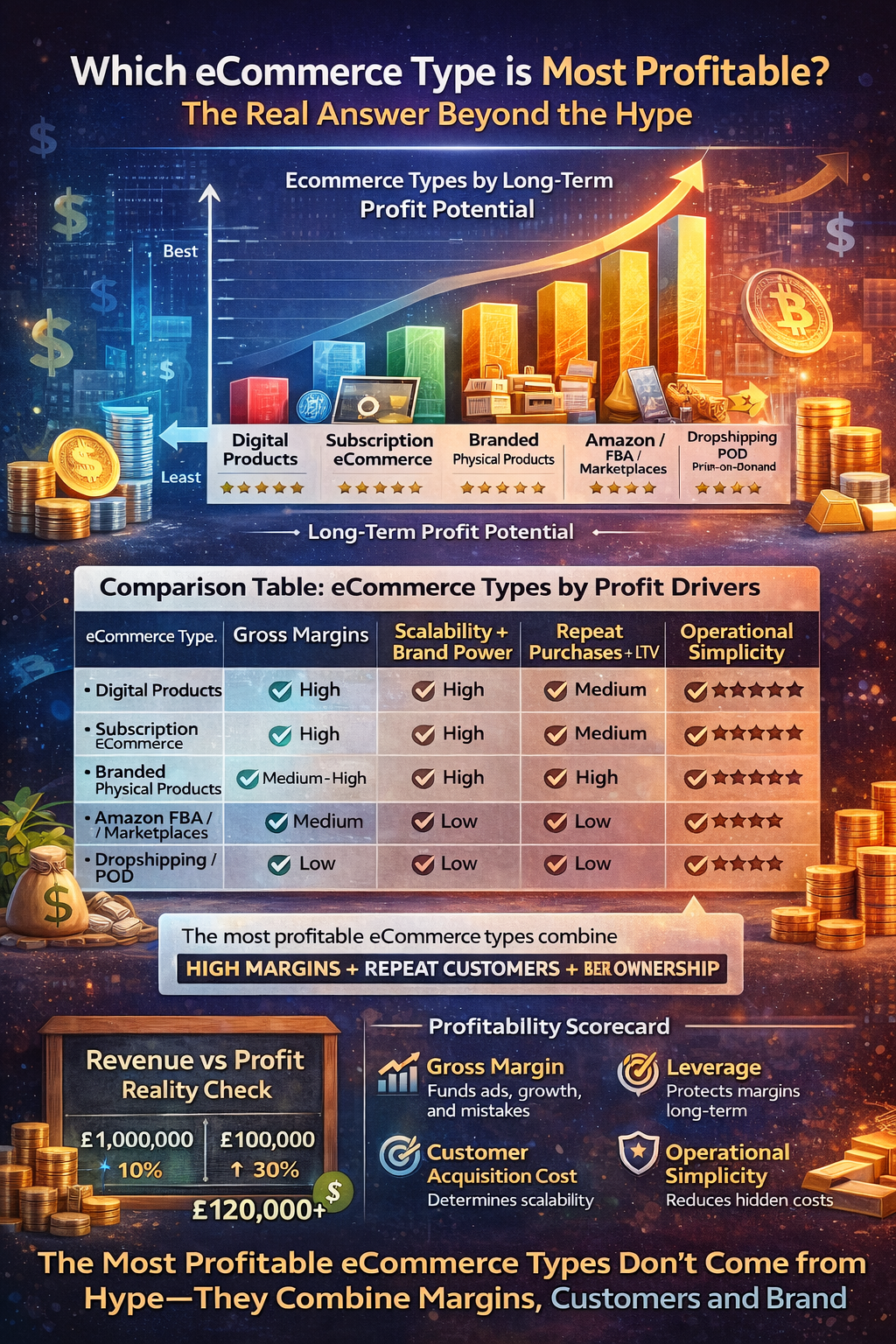
Models like digital products, subscriptions, and branded products make this easier, which is why they dominate the top tier of profitable eCommerce businesses.
The model sets the ceiling. Execution decides where you land.